
Season after season
The labour that makes the oil.
First the hands. Now the arm.
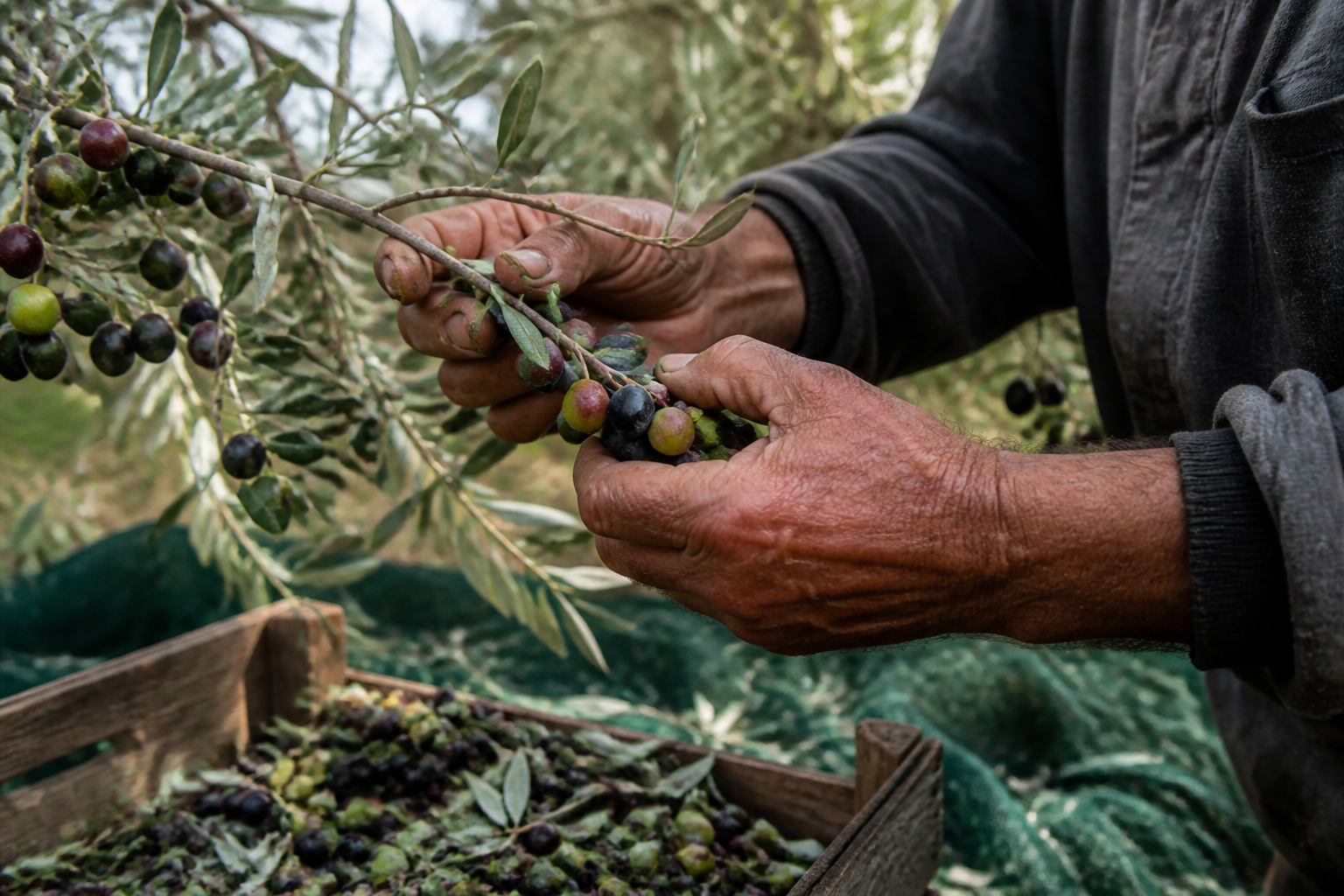
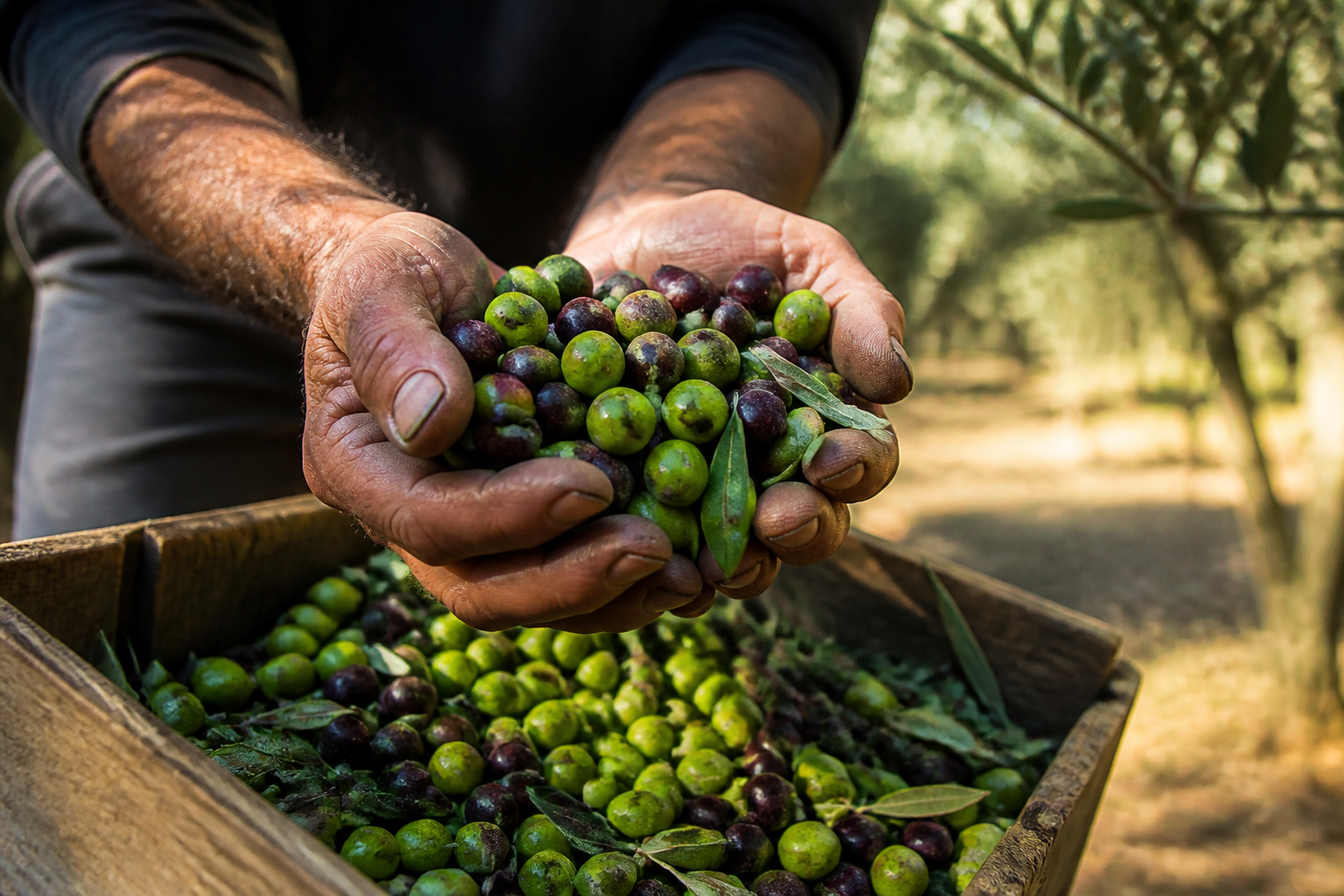
For generations, on the terraces of Fara in Sabina, olives were taken by hand: nets on the ground, ladders, a bent back, one tree at a time. That way taught us when the fruit is alive — just turning colour, not too green, not too ripe. Today we harvest with a mechanical arm: a canopy shaker, guided by us, that drops the olive onto the cloth without wounding the trunk and without leaving the crop on the soil. It is not the lowland machine that strips a row. It is the same respect, in the olive’s time. Crates, not sacks. Within hours, the mill.
The whole hill on the right day
By hand, harvest lasted weeks: the last trees waited while the first had already passed. The arm closes a row in days, not months. The eye still chooses the colour change; the machine lets us be on time across the whole hill.
Intact fruit, not on the ground
The arm shakes the canopy, the cloth gathers. No fruit piled on the soil, no acidity rising before the mill. The drop is cleaner than a trunk shaker, which wounds the wood and also brings down what is not ready.
At the mill the same day
Fewer hours between tree and crusher: less oxidation, more polyphenols, more green. The right hurry is the olive’s, not the market’s. The arm gives us the speed to deserve it.
Less back, the same care
Ladders and combs remain for trees the arm cannot reach. Elsewhere the family’s hands guide the machine instead of stripping every branch by hand. The labour does not vanish: it moves to pruning, mowing, the mill — where the oil’s character is decided.
The rest of the year is not rest.
Pruning for air and light, mowing, mending dry-stone walls, cover grass, waiting. Organic farming removes the shortcuts: grass is cut, not poisoned; peacock spot and the olive fly are prevented with air, traps, kaolin — not a convenient spray. It is a calendar of small, repeated gestures that never appear on the label and decide everything.
Nights at the mill.
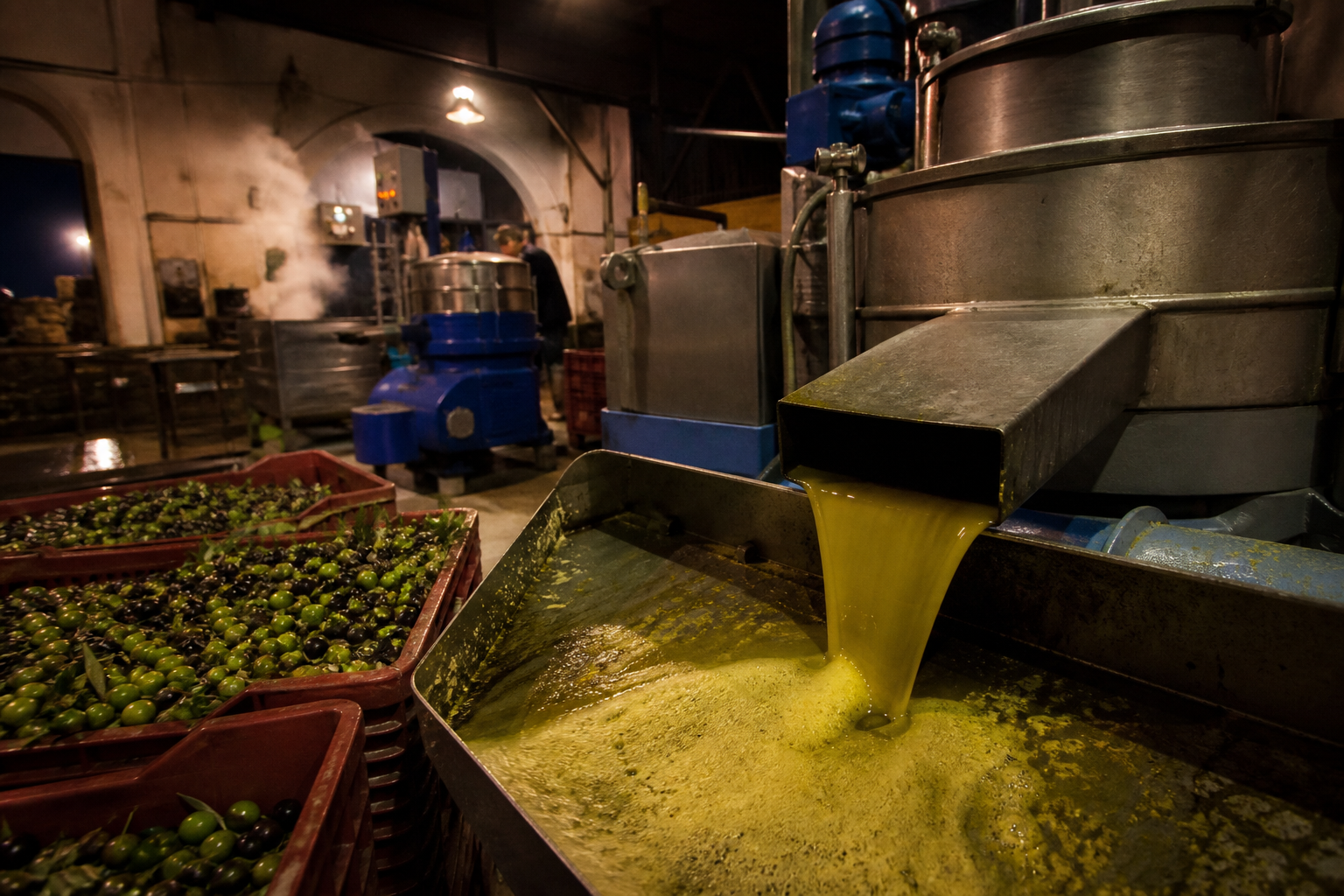
When harvest begins, sleep shortens. Defoliation, washing, crushing, cold malaxing, decanter, separation. Then the filter and steel under nitrogen: the oil is not left “raw” to wait. Every batch is tasted. If it does not speak of Fara in Sabina, it does not go in the bottle. We bottle in dark glass, on the estate, lot by lot. The only hurry here is the olive’s: it will not wait.
After the mill
EVO filtering and rest under nitrogen.
Cold extraction is not enough. If the oil stays cloudy and open to the air, in a few weeks it loses what the hill spent a year making. We filter the extra virgin and keep it in steel, under nitrogen, until the bottle.
EVO filtering.
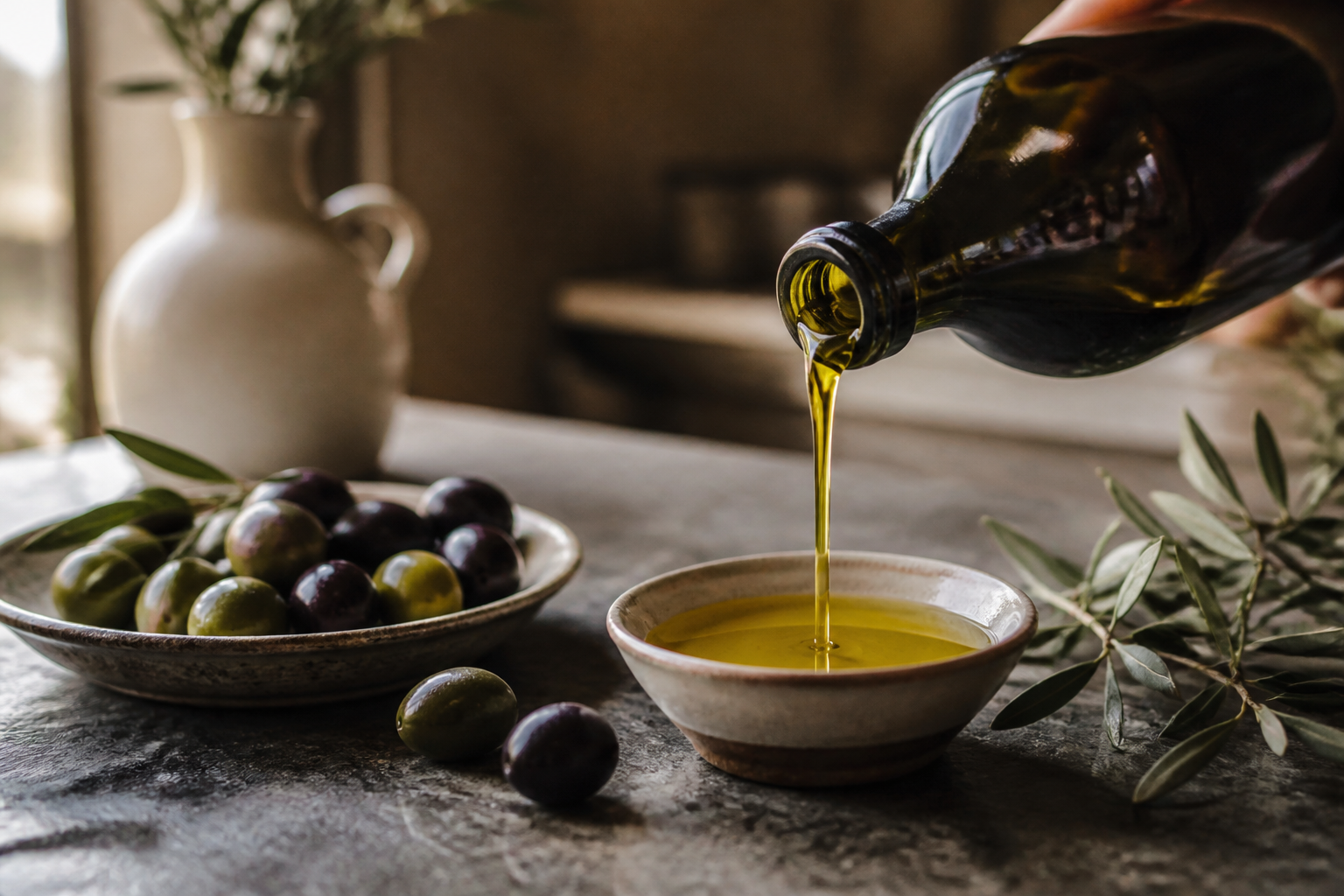
Just out of the decanter the oil is alive — and still full of water and sediment. That cloudiness, as new oil, has a charm. Then it ferments, tastes of lees, spoils. Extra-virgin filtering takes out moisture and solids without refining, heating or solvents: it remains extra virgin. What changes is how long it stays extra virgin.
It is not refining
No deodorising, no high temperatures, no chemistry. The oil passes through cellulose plates or inert filters. Water and particles leave. Bitterness, pepper, polyphenols and the vintage stay.
Fewer faults, longer life
Water and paste residues are a bed for fermentation. Removing them, the oil does not go to sludge in the cellar and does not develop winey or fusty notes. The sip stays clean from January to October.
Clarity you can see
In the bottle the oil is bright, green-gold, stable. Whoever wants November’s haze finds it at the mill, in November. What we ship home is made to last on the table, not for one week of celebration.
Storage under nitrogen.
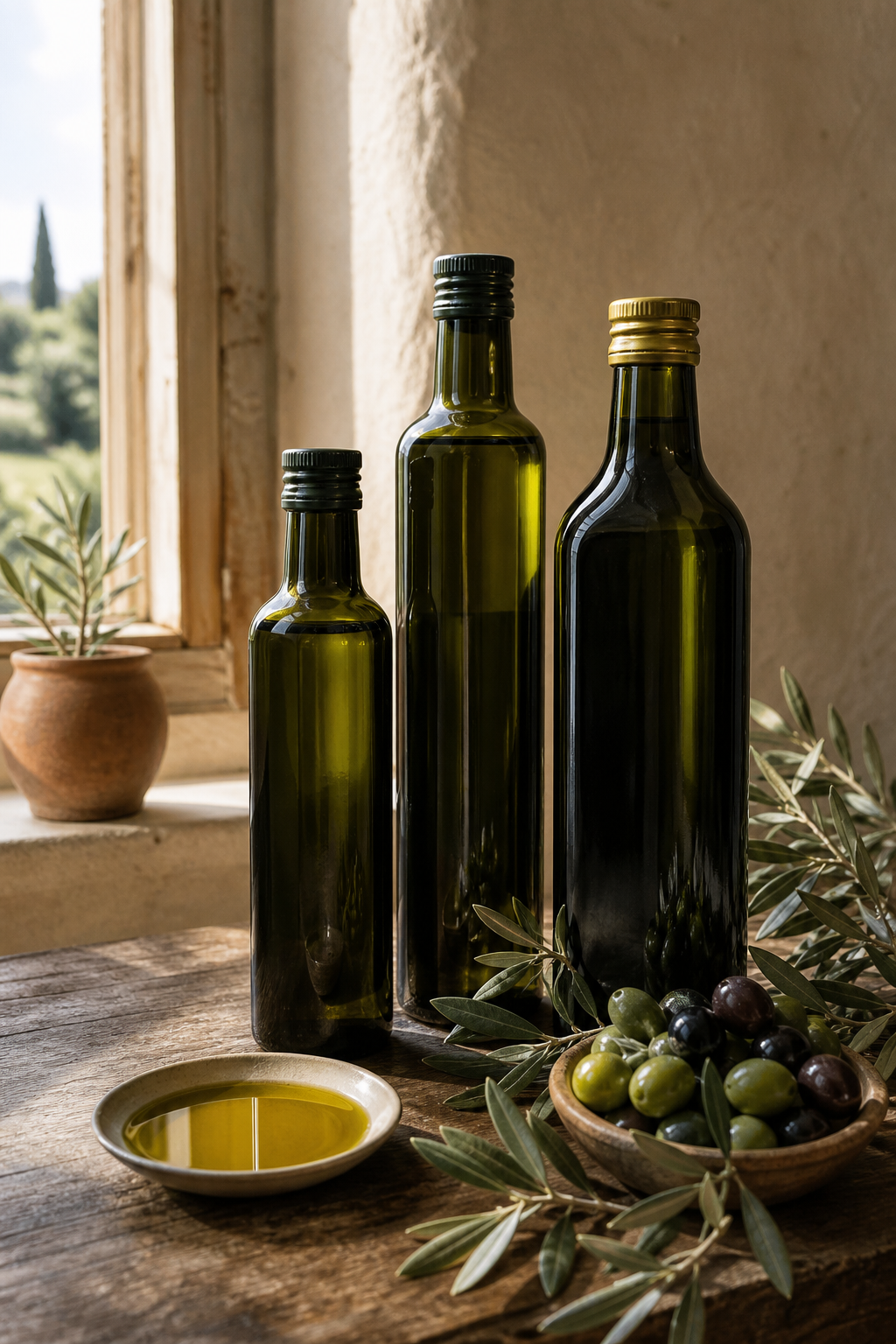
Oxygen is extra virgin’s quiet enemy: it darkens, flattens, turns rancid. So the oil does not wait in an open jar. It rests in stainless-steel tanks, in the dark and the cool, with the tank’s headspace filled with nitrogen — an inert, tasteless gas that keeps air off the surface.
A cushion without oxygen
As we draw oil to bottle, nitrogen takes the empty space. No air chamber “breathing” on the oil. Peroxides rise slowly; the pepper stays.
Steel, darkness, cold
Stainless steel gives off no smell. Darkness stops the light. Low temperature slows the reactions. Nitrogen closes the fourth side: the one the old jar could not close.
Then dark glass
In the bottle the oil leaves the tank’s nitrogen for dark glass, filled, capped. Analysis (acidity, peroxides) and tasting before every lot. If air has already entered the cellar, the label cannot fix it.
The mill
A modern mill in the service of an old gesture.
Tradition decides when and how to pick. Technology is there so aroma, polyphenols and the vintage are not lost. We use no solvents, we do not refine, we do not heat. We extract, protect, bottle.
01
From crate to crusher
Olives arrive in crates, are destemmed and washed. Crushing is done with stainless-steel hammers: it replaces the old stone millstones, is cleaner and faster, and gives the fruit no time to oxidise.
02
Malaxing below 27 °C
The paste is stirred slowly, at a controlled temperature, always below 27 °C — the cold-extraction limit. Short times: long enough for oil droplets to join, not long enough to cook the aromas. Here it is decided whether the extra virgin will stay green, bitter, peppery.
03
Two-phase decanter
Extraction is continuous, with a two-phase centrifugal decanter: little added water, more polyphenols kept, wetter pomace. No hydraulic presses left in the air, no heating to “pull” more oil. Lower yields. Truer oil.
04
Filter, steel, nitrogen, dark glass
After the decanter we filter, then the oil rests in stainless steel under nitrogen — away from light, heat and oxygen. It is analysed and tasted. It is bottled in dark glass, in small lots, on the estate. No long stay in plastic, no anonymous blend of mixed origins.
05
What the mill does not do
No chemical solvents (those belong to pomace, not extra virgin). No deodorising, no refining, no high temperatures. If a batch fails the panel test, it does not become “cooking oil” under another name: it does not go into a Blanchi bottle.
Organic farming
What we use — and what we will never use.
Organic, for us, is not a badge. It is a precise list of allowed gestures and refused shortcuts. We work under the EU organic farming regulation, with a control body and traceability of every lot. Below, without circling: what enters the grove and what stays out.
What we use
Cover grass and mowing
Grass under the trees is allowed to grow and then cut. It protects terrace soil from erosion, feeds life in the ground, and does not compete in summer the way chemical weeding pretends.
Compost, manure, pruning wood
Fertility comes from organic matter: farm compost, mature manure, chipped prunings. No synthetic salts. Sabina’s lean soil is fed slowly, and the olive stays concentrated.
Pruning for air and light
The first defence is the shape of the tree: an open canopy, air moving through, less humidity, less peacock spot. It is the oldest gesture, and still the most effective.
Kaolin and mass trapping
Against the olive fly we use physical barriers (kaolin: a white clay that coats the fruit) and pheromone or food traps. We prevent. We do not bombard.
Copper in limited doses
Against peacock spot, when needed, copper within EU organic limits. It is not a free pass: it is the last line, after pruning, air and watching.
Hill biodiversity
Hedges, wild grasses, useful insects. A grove as clean as a car park is a fragile grove. Life around the trees is part of the method, not décor.
What we do not use
This list matters as much. It is what makes our extra virgin organic — and harder to make.
Synthetic herbicides
No glyphosate, no foliar or residual weedkillers. Grass is cut. It costs days. The soil stays alive.
Synthetic insecticides
No dimethoate and the like against the fly, no neonicotinoids, no calendar sprays independent of what is happening in the grove.
Chemical fertiliser
No synthetic nitrogen, phosphorus or potassium to push the tree to yield more. The crop is decided by the year, not by a sack.
Systemic fungicides
No active ingredients that travel in the sap. Disease is prevented with air, pruning and, if need be, copper within limits.
Forcing and regulators
No push irrigation where it is not needed, no products to ripen in a hurry, no “helps” to raise mill yield by heating the paste.
Ground fruit and waiting
No olives picked from the ground, no days of rest in sacks. Acidity rises there, before the mill.
Why we do this labour.
Because ordinary oil can be bought anywhere. An organic extra virgin that tastes of this hill, this family, this stubbornness — that is made only this way. We do not want to be the biggest. We want to be the finest: the organic oil of Fara Sabina that is the best in the world.
Bring it to the table